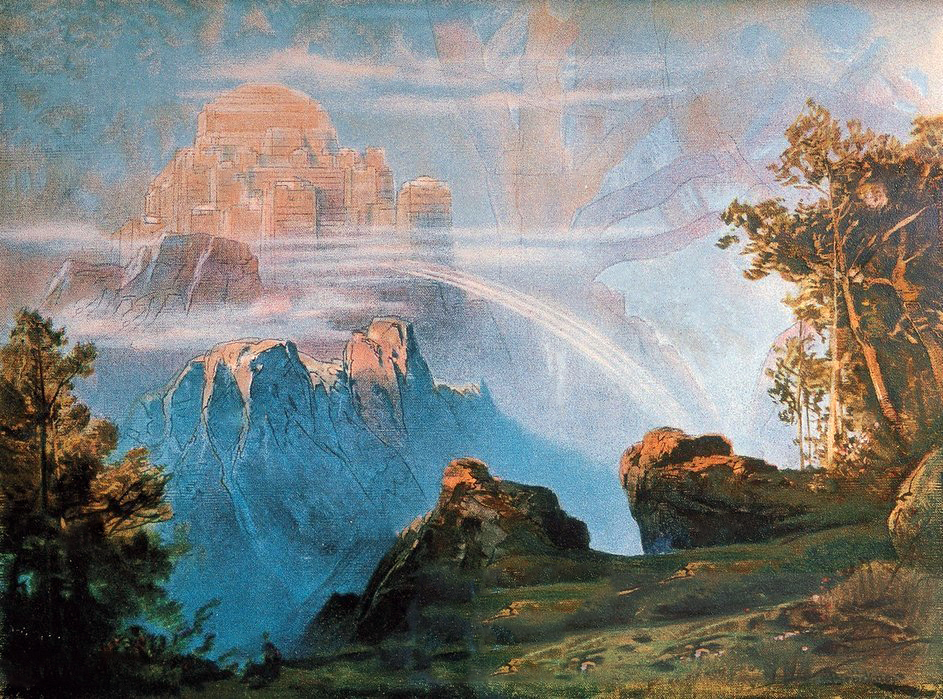
Dwelling of the Æsir; contains Valhöll, Fólkvangr, Sökkvabekkr, Gimlé and further halls.
Asgard is the dwelling of the gods, a fortified stronghold in the heavens inhabited by the Aesir. According to Völuspá, the original stronghold was built during the world's early age, a time of peace and fellowship before the conflict with the Vanir erupted. Grímnismál enumerates twelve or more halls within Asgard, each associated with a specific deity.
Among Asgard's most important sites are Glaðsheimr, the great hall where Odin holds council with the twelve Aesir, and Valhöll, the hall of the slain warriors. Vingólf is the sanctuary of the goddesses, while Þórr dwells in Þrúðheimr and Freyr in Álfheimr. Bifröst, the multicoloured bridge, connects Asgard to Midgard and is guarded by Heimdallr.
Asgard's walls were originally built by an anonymous builder who demanded the sun, the moon, and Freyja as payment. The gods agreed on condition that the work be completed in a single winter using only one horse for assistance. Loki sabotaged the project when it became clear the builder, a giant, was close to succeeding. The wall was never fully completed, which accounts for its vulnerability at Ragnarök.
At Ragnarök, Asgard's boundaries are breached when Surtr leads the sons of Múspell across the shattered Bifröst. The gods' home burns, and the cosmic order dissolves. The Eddas suggest, however, that a new, purer Asgard rises in the renewal that follows.
Sources in the Eddas
- Völuspá 7
- The gods' early settlement and the building of Asgard.
- Grímnismál 4-17
- Enumeration of the halls in Asgard and their respective deities.
- Gylfaginning 42
- The giant builder's work and Loki's deception.
- Grímnismál 13, 29
- Bifröst and Heimdallr's watch at the bridge to Asgard.
- Völuspá 52
- Surtr's fire and Asgard's fall at Ragnarök.
Interpretive traditions
A What we know
Asgard is the gods' stronghold, located in the heavens and connected to Midgard via Bifröst.
Grímnismál names multiple halls within Asgard associated with specific deities.
Valhöll and Glaðsheimr are the most prominent buildings.
B What we think we know
Whether Asgard was conceived as geographically located in the sky or as a remote place on earth's surface is debated.
The relationships between the various halls and their exact functions are not always consistent across the sources.
C What we do not know
Whether Asgard had a cultic counterpart in prehistoric Scandinavian religion or is exclusively a literary concept is unknown.
How Asgard relates to the Germanic sacred mountain concept found elsewhere in Germanic tradition is unclear.