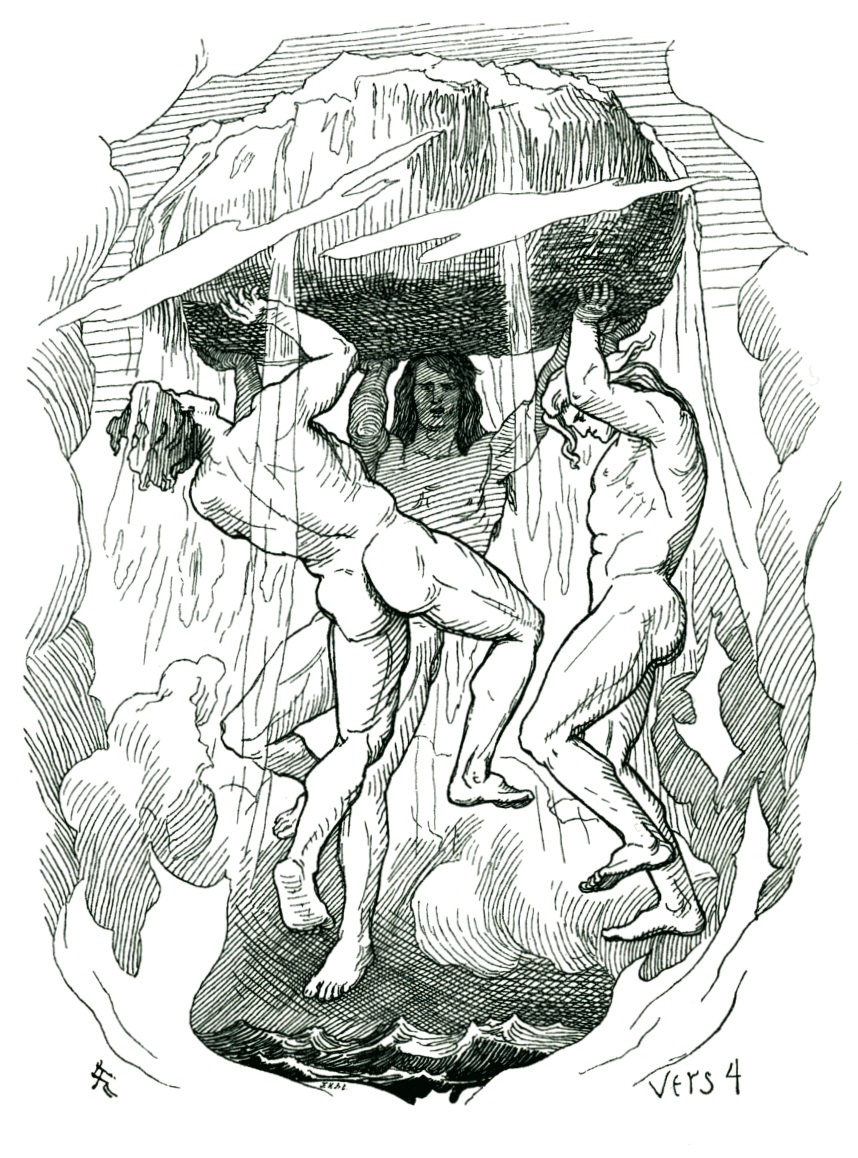
The yawning void in the time before time, between Niflheim and Muspelheim.
Ginnungagap, 'the yawning void' or 'the magically charged gap', is the primordial emptiness that preceded creation. In the opening of the Völuspá, the poet implies a time before seas, trees, and sky existed, when there was nothing. Grímnismál and Gylfaginning refine the picture: to the north lay the ice-cold Niflheimr with its poison-laden rivers, the Élivágar, and to the south blazed Múspellsheimr with fire. Between them yawned Ginnungagap, free and empty.
Creation occurred when the ice from the north and the sparks from the south met in the middle of the gap. The ice melted and a rime-frost being emerged: the primordial giant Ymir. From his sweating body the first beings formed. The cow Auðhumla licked blocks of salty rime-stone and revealed Búri, the ancestor of the gods. The conflict between gods and giants thus begins in Ginnungagap, and without this gap neither gods nor humans would have existed.
The name is often analyzed as a compound of 'ginnr' (wide-open, empty, or magical) and 'gap' (abyss, opening). Snorri seems to understand the place as a concrete geographical emptiness between the two primordial zones, but the poetic tradition suggests rather a conceptual pre-existence without form. Parallels exist in other Indo-European cosmogonic myths, where chaos or void precedes order.
Sources in the Eddas
- Völuspá 3
- The völva describes the primordial time before creation, when Ginnungagap was the only reality.
- Vafþrúðnismál 31
- Vafþrúðnir answers Odin's questions about Ymir's origin and Ginnungagap's role in the creation narrative.
- Gylfaginning 4-8
- Snorri gives the most detailed description of Ginnungagap, the meeting of ice and fire, and the emergence of Ymir.
Interpretive traditions
A What we know
Ginnungagap is the primordial void that existed before the cosmos was created, located between Niflheimr and Múspellsheimr.
Ymir was formed when ice and fire met in the gap; his body was then used by the gods to create the world.
Auðhumla, the primordial cow, appears consistently in the sources as the one who nourishes Ymir and reveals Búri.
B What we think we know
Whether 'ginnr' in the name means 'magical' or simply 'wide-open/empty' is linguistically debated.
Whether Ginnungagap is a purely geographical place or a metaphorical description of a state of non-existence is debated among scholars.
Possible parallels between Norse creation mythology and other Indo-European traditions are contested.
C What we do not know
Whether Ginnungagap continues to exist as a place in the cosmos after creation, or whether it ceased to exist, is unknown.
Ginnungagap's exact cosmological position in relation to Yggdrasil and the nine worlds is not specified in the sources.
Whether Ginnungagap plays any role at Ragnarök or re-emerges after the world's destruction is not addressed in the surviving texts.