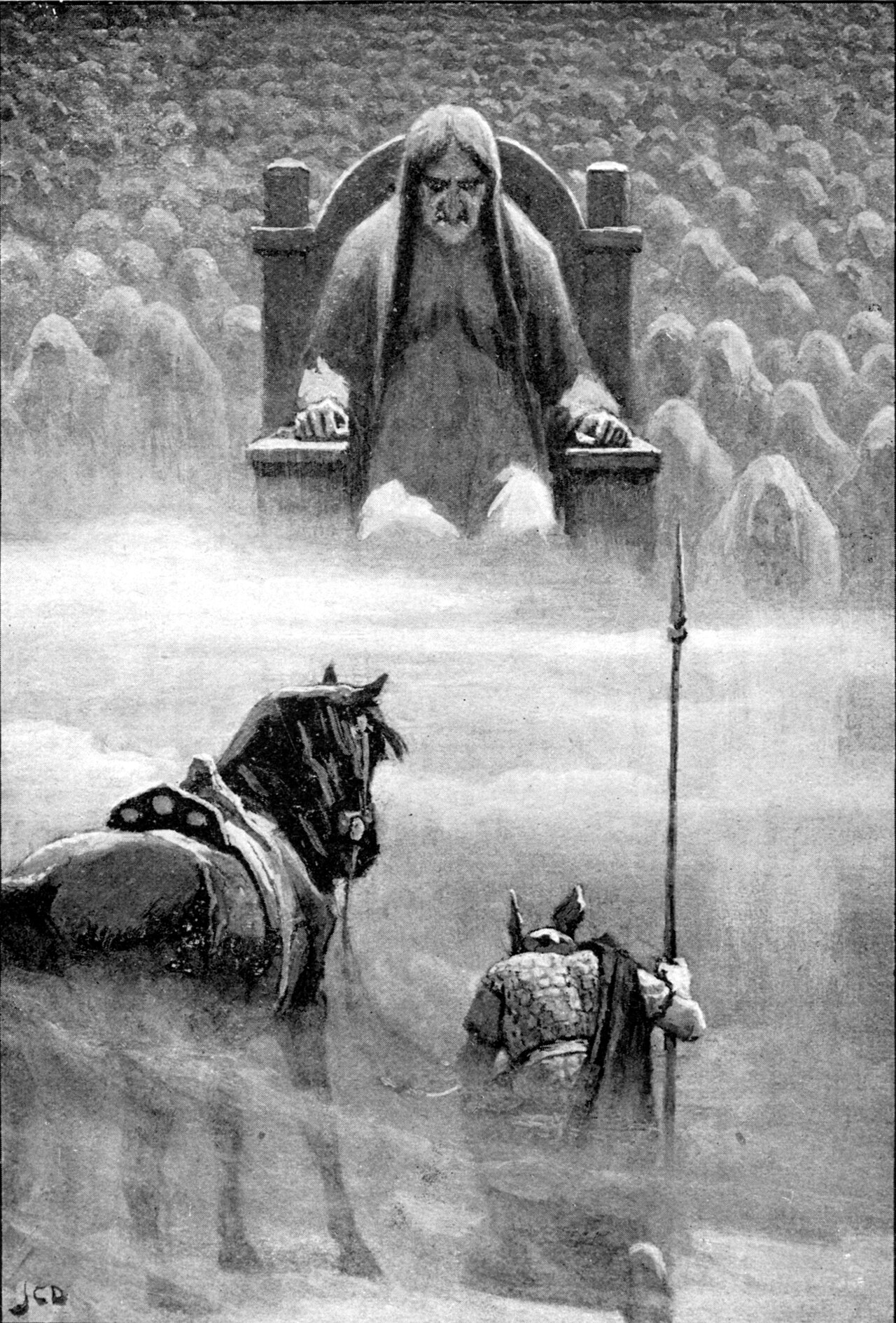
The realm of the dead beneath one of Yggdrasil's roots, ruled by Hel.
Helheim is the realm of the dead, located beneath one of Yggdrasil's three roots. It is ruled by Hel, daughter of Loki and the giantess Angrboða, whose body is half living flesh and half decayed. Those who die of illness, old age, or accident travel here, unlike the battle-slain who go to Valhöll or Fólkvangr. The hall of Queen Hel is called Éljúðnir; her plate is named Hunger, her knife Famine. Her manservant is Ganglati and her maidservant Ganglöt.
Hermóðr's ride to Helheim to retrieve Baldr is one of the most dramatic episodes in Norse mythology. He rides Sleipnir for nine nights through dark and deep valleys, crossing the Gjöll bridge, covered in glittering gold, which is guarded by the maiden Móðguðr. She tells him that Baldr passed over the bridge the day before at the head of a host of dead men. Hermóðr rides on, leaps the gates of Hel, and finds Baldr seated in the place of honor in the hall.
The sources differ on the exact geography of Helheim. The Völuspá and Grímnismál suggest the realm is surrounded by rivers and boundaries, and the Élivágar rivers are sometimes associated with this region. There are also traditions of an innermost dark shore, Náströnd, where murderers and oath-breakers are punished, and to which Níðhöggr comes to suck the blood of corpses.
Sources in the Eddas
- Gylfaginning 49
- Hermóðr's ride to Helheim and the encounter with Móðguðr and Hel are described in Snorri's prose.
- Völuspá 38-39
- The völva describes Náströnd, the punishment shore for murderers and oath-breakers, and Níðhöggr's activity in Helheim.
- Grímnismál 31
- Odin mentions in passing Hel's dwelling and its location in relation to Yggdrasil.
- Gylfaginning 34, 49
- Snorri describes Hel, her hall Éljúðnir and its furnishings, and Hermóðr's visit in detail.
Interpretive traditions
A What we know
Helheim is located beneath one of Yggdrasil's roots, in a direction associated with the north and below.
The realm is ruled by a being named Hel, whose name shares a root with the Old Norse word for 'to conceal' or 'to cover'.
Hermóðr rode there to negotiate Baldr's return; Hel set the condition that all beings must weep for Baldr.
B What we think we know
Whether Helheim and Niflheimr are the same place or distinct realms is debated; Snorri sometimes equates them, but the poetic sources are more ambiguous.
It is unclear whether 'the ninth world' mentioned in Völuspá 2 refers specifically to Helheim or a broader cosmological category.
The relationship between Náströnd and Helheim in general is not clearly established; Náströnd may be a separate punishment area rather than part of the general realm of the dead.
C What we do not know
What exactly happens to the dead in Helheim beyond their simply being there is largely unknown from the surviving sources.
Whether the dead in Helheim have any form of active existence, or whether it is purely passive, is not clearly stated.
The geographical extent of Helheim and any internal divisions it may have are almost entirely unknown beyond the few clues the sources provide.