About this story
The end of the world and its rebirth: Fimbulvetr, the unleashed enemies, the fall of the gods, the rising of the earth from the sea, the survivors.
A The Fimbulwinter
Ragnarok begins with three consecutive winters. The Fimbulwinter, "the great winter", fills Midgard with driving snow and cutting cold across three unbroken years with no summer intervening. The sun gives no warmth. Harvests fail. Animals die. The Fimbulwinter is a climatic catastrophe and, simultaneously, a social collapse: when food runs out, the bonds of community break.
Allegiances dissolve. Brother slays brother. Sister's sons betray the loyalty owed to kin. Völuspá 45 captures the scene with spare precision: brothers fight and deal each other death-blows, sister's sons break the faith of kinship. The moral state is a sign of a world that has lost its inner ordering. No one respects another's right; no one fulfils the obligation that binds a society.
Vafþrúðnismál 44 confirms the triple winter and adds that the wind scours from every direction. The connection between cosmic and ethical dissolution runs through both poems: the natural phenomenon and the human crimes are simultaneous symptoms that the age is reaching its end, linked in meaning rather than as cause and effect.
Brœðr munu berjask
ok at bönum verðask,
munu systrungar
sifjum spilla.
Brothers shall fight
and deal each other death-blows,
sisters' sons
shall break the bond of kinship.
own translation
Fimbulvetr hinn mikli,
er ferr um veröld,
þrjá vetr samfleytt
áðr þá þrír koma.
The great Fimbulwinter,
that sweeps over the world,
three winters together
before those three come.
own translation
A The Bound Enemies Unleashed
During the last winters of the Fimbulwinter the fetters binding the enemies of the gods are broken. Fenrir, the wolf bound by the gods with the magical chain Gleipnir, shatters his bonds. His jaws gape so wide that the upper jaw reaches the sky and the lower jaw scrapes the earth. Jörmungandr, the Midgard Serpent that encircles the inhabited world beneath the sea, rises from the deep. The ocean crashes over the shores.
Loki, who has borne his punishment since he brought about Baldr's death and mocked the gods at Aegir's feast, breaks free and rides toward the enemies of the gods. His liberation is the precise moment at which order is released into its own dissolution. Völuspá 46-47 sequences these events in a compressed and forceful language that simply states.
It is worth noting that the poems differ in sequence. Völuspá addresses the loosing of Fenrir and Jörmungandr in 46-47, while Loki's release is treated more implicitly. Vafþrúðnismál provides a somewhat different chronological framework. Neither the poem nor Snorri's prose in Gylfaginning is intended as a precise moment-by-moment account; they are theological panoramas.
Geyr nú Garmr mjök
fyr Gnipahelli,
festr mun slitna,
en freki renna;
fjölð veit ek fræða,
fram sé ek lengra
um ragna rök,
röm sigtíva.
Loud barks Garm now
before Gnipahellir,
the fetter shall break
and the hungry one run free;
many things I know,
further forward I see
the fate of the gods,
the victory-gods' great strife.
own translation
A Naglfar and Hrymr
From the east comes Hrymr, giant and warrior, shield held before him. The serpent Jörmungandr churns the sea as it rises from the deep. The eagle shrieks. Naglfar breaks free from its moorings. Naglfar, the ship built from the nails of the dead, is one of the most distinctive motifs in Old Norse eschatology. Every person who dies with untrimmed nails contributes to the ship's construction, which is why the nails of the dead were traditionally cut. The ship is an antithesis to the ordering of creation: built from what should have been discarded, rigged for destruction.
Aboard Naglfar sails Loki as helmsman, in Gylfaginning's version of the story, with the people of Hel as crew. Surtr rides from the south with his blazing host. The Múspellsmegir, the sons of Muspell, ride over Bifröst, the rainbow bridge connecting Asgard and Midgard. The bridge shatters under their weight. The breaking of Bifröst marks the severing of communication between the world of the gods and the human world; the cosmic geometry collapses.
Völuspá 49-52 sequences these events. The stanzas are dense and require interpretation; some details, above all Loki as Naglfar's helmsman, appear in Snorri but are absent from the poem itself. That detail carries epistemic category B: probably part of the same mythic tradition but not directly attested in the Eddic text.
Surtr ferr sunnan
með sviga lævi,
skínn af sverði
sól valtíva;
Surtr fares from the south
with the scathe of branches,
there shines from his sword
the sun of the slaughter-gods.
own translation
Hrymr ekr austan,
hefisk lind fyrir,
snýsk Jörmungandr
í jötunmóði.
Hrymr drives from the east,
his shield raised before him,
Jörmungandr writhes
in giant rage.
own translation
A The Horn of Heimdallr
Heimdallr, the warden at the boundary of the divine world, blows the Gjallarhorn. The horn is heard in all the worlds. It is the signal to the gods to muster their armies and make ready for the final battle. Völuspá 46 delivers the moment brief and forceful: Yggdrasil's ash tree shakes and stands, the ancient tree groans, and the giant is on the move. The world-tree trembles. The cosmic axis is no longer stable.
Odin rides to the well of Mimir to seek counsel before what is to come. Mimir, whose head Odin has preserved and conversed with since the war between the Aesir and the Vanir, possesses the deepest wisdom. What they say to each other the poem does not reveal. Odin's consultation of Mimir's head is one of the more melancholy moments in the Ragnarok cycle: the most powerful of gods seeks knowledge before an approaching catastrophe he knows to be unavoidable.
The gods arm themselves. The Einherjar, the fallen warriors in the great hall of Valhalla, are called to battle. The horses of the Aesir are saddled. Frigg, one may infer, thinks of her son Baldr in Hel. All of Asgard prepares for a struggle everyone knows will be the last.
Skelfr Yggdrasils
askr standandi,
ymr it aldna tré,
en jötunn losnar.
Trembles Yggdrasil's
ash tree standing,
the ancient tree groans,
and the giant breaks free.
own translation
Þá gengu regin öll
á rökstóla,
ginnheilög goð,
ok of þat gættusk.
Then all the powers
went to the judgment-seats,
the most holy gods,
and took counsel thereon.
own translation
A The Battle of the Gods on Vígríðr
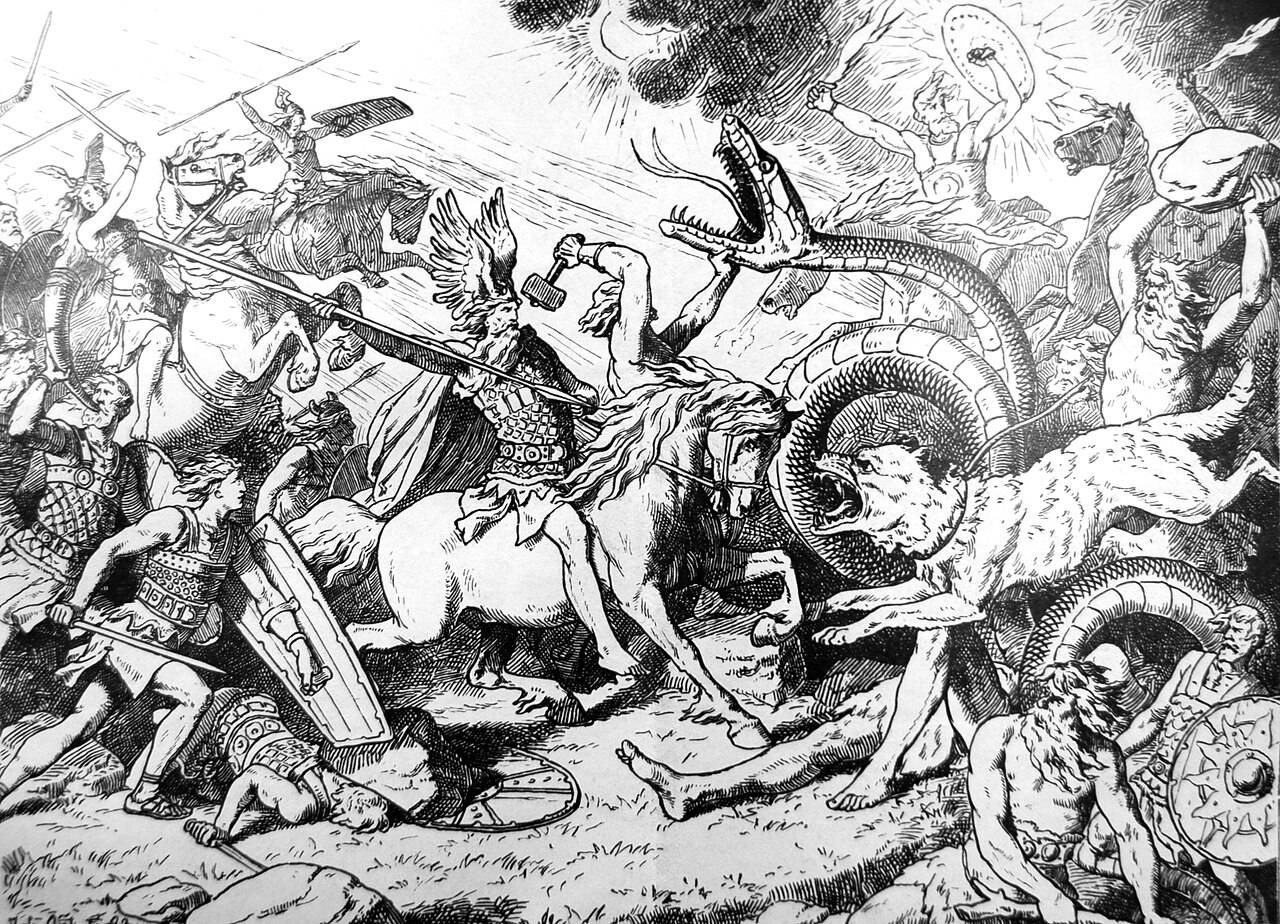
The battlefield is called Vígríðr and is, according to Vafþrúðnismál 18, a hundred leagues wide in each direction. On that field the gods and their enemies meet in the battle for which the poems have reserved their most powerful stanzas. Odin rides against Fenrir with the spear Gungnir. The wolf swallows him. Odin, the Allfather, the king of the gods, dies in Fenrir's jaws. This is one of the most startling statements in Old Norse eschatology: the mightiest god meets his destruction.
Víðarr, the son of Odin, avenges his father. He plants his thick shoe against Fenrir's lower jaw and tears the wolf's mouth apart, or drives his blade through the palate, depending on the source. Víðarr's shoe is made from the leather scraps cobblers discard with each pair of shoes, which is why such scraps have always been set aside for Víðarr. Thor fights Jörmungandr and kills the serpent, but then staggers back nine paces and falls dead from its venom. Freyr meets Surtr but lacks his sword, which he gave away to win Gerðr's love. He falls.
Týr and Garmr kill each other. Heimdallr and Loki kill each other. The pairings are carefully choreographed across the poems: each god's death is bound to a specific enemy. Vafþrúðnismál 51-52 confirms several of these death-combats. It is a theology of fated fulfilment: the gods know their destinies and walk toward them without flinching.
Þá kemr inn mæri
mögr Hlöðynjar,
gengr Óðins sonr
við orm vega;
drepr hann af móði
Miðgarðs véur,
munu halir allir
heimstöð ryðja.
Then comes the famous
son of Hlódyn,
the son of Odin strides
against the serpent;
he strikes in fury
the Midgard-guardian dead,
all men must
leave their homesteads.
own translation
Víðarr ok Váli
byggja vé goða,
þá er sloknar Surta logi.
Víðarr and Váli
shall dwell in the gods' sanctuary,
when Surtr's flames are quenched.
own translation
A The Fire of Surtr
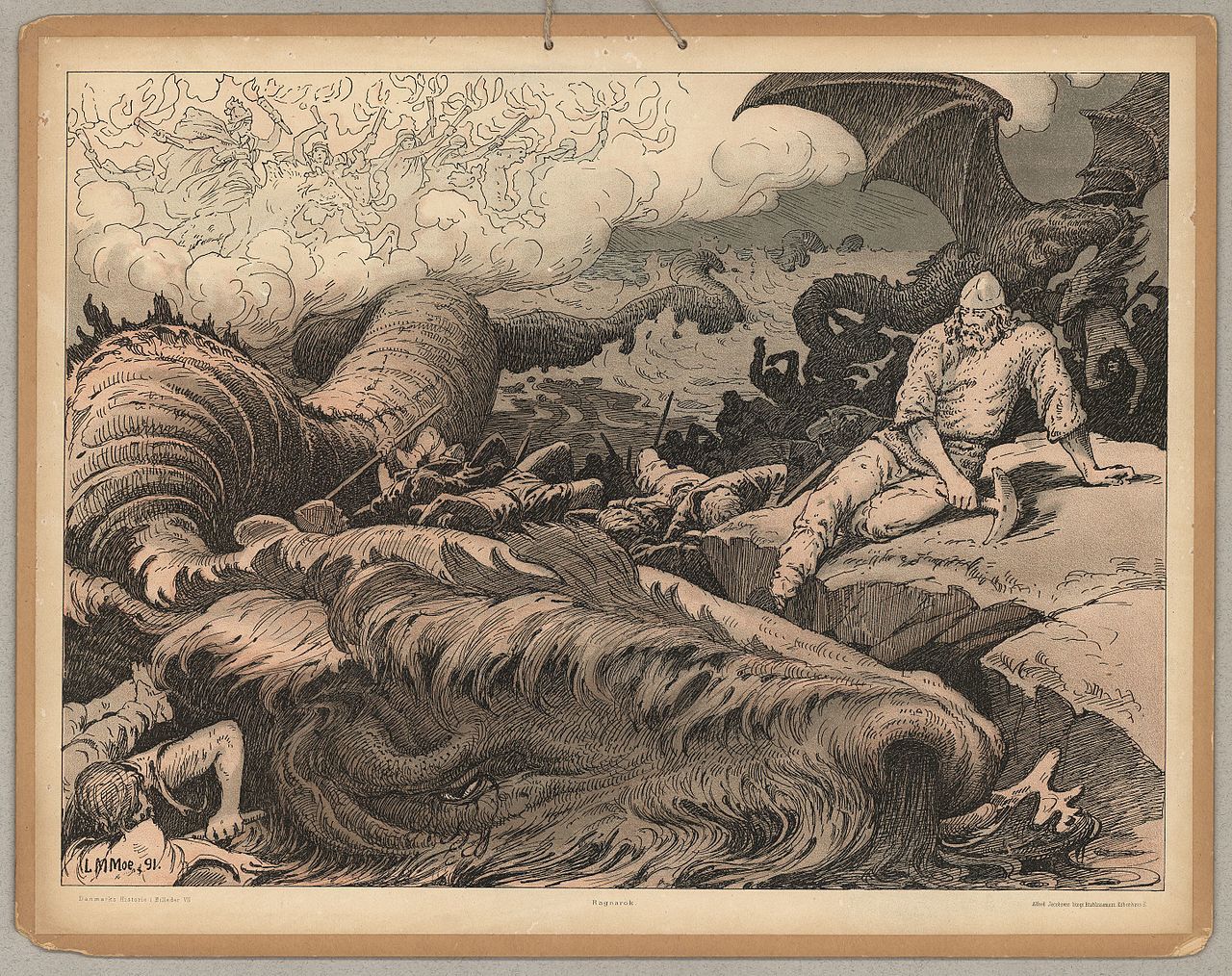
When the battle is decided, or in its final phase, Surtr casts fire across the entire world. Völuspá 57 gives the scene in two lines of impossible compression: the sun darkens, the land sinks into the sea, the bright stars vanish from the sky. Surtr's act is not war in the ordinary sense; it is a cosmic annulment. He brings to an end all the preconditions for existence.
It is significant that Surtr, rather than Loki or Fenrir, performs the final destruction. Surtr is from Múspellsheimr, the primordial realm of fire. His action is in one sense a return to the condition that prevailed before the world was made from Ymir's body. The act of creation is reversed. The world-fire is the final destination of the cosmic dissolution.
The sinking of the world into the sea underscores the symmetry with the creation narrative: the world emerged from a form of chaotic pre-existence; now it returns there. Snorri's Gylfaginning 51 expands the scene with details about Asgard burning and the gold of the temples melting. This is likely a prose elaboration of the poem's terse stanza, but the symbolic connection is governed by the same imagery.
Sól tér sortna,
sökkr fold í mar,
hverfa af himni
heiðar stjörnur;
geisar eimi
við aldrnara,
leikr hár hiti
við himin sjalfan.
The sun darkens,
the land sinks into the sea,
from the sky fall
the bright stars;
steam rises
against the life-sustainer,
high heat plays
against heaven itself.
own translation
B The Rebirth of the Earth
Völuspá does not end with destruction. Stanzas 59-65 reverse the perspective: from the sea rises a new earth, green and fair. Eagles svävar above waterfalls. On the empty plains grain grows by itself, unsown. The Aesir return to Iðavöllr, the same place where they once, in the morning of creation, gathered to play board games and build the first divine temple.
Epistemic category B is warranted. These stanzas are in Codex Regius and are part of the attested text, but their interpretation is heavily debated. An influential school, beginning with Sigurður Nordal (1923) and followed by several scholars, has read the rebirth stanzas as Christianly influenced. The idea of a new paradise, of a resurrection of the gods, of a coming righteous judge (st. 65) follows Christian patterns of thought. Another school, including Hultgård (1990) and Lindow (2001), holds that rebirth ideas are attested in pre-Christian Iranian and Germanic eschatology and may be pre-Christian.
It is not possible to resolve the question without new source material. The text as we have it is from the Codex Regius of the 1270s, and the redactor's hand may have shaped it. Reading the stanzas as pre-Christian eschatology is defensible; reading them as Christian interpolation is equally defensible. This page presents them as the attested text-stanzas they are, with the call for source-critical reflection built in.
Sér hún upp koma
öðru sinni
jörð ór ægi
iðjagrœna.
She sees rising up
a second time
the earth from the ocean
fresh and green again.
own translation
Falla forsar,
flýgr örn yfir,
sá er á fjalli
fiska veiðir.
Waterfalls tumble,
the eagle flies over,
he who on the mountain
hunts for fish.
own translation
B The Survivors
Baldr and Höðr return from Hel. Völuspá 62 presents this without explanation: the two brothers, the killer and the killed, live together in the new world without the poem making the old conflict its theme. It is also one of the quietest moments in the cycle: no vengeance, no recrimination, only the fact of return. Some interpret this as a reconciliatory eschatology; others see it as evidence of Christian influence, paired with the resurrection parallel.
Líf and Lífþrasir, "Life" and "The one who clings to life", have hidden in Hoddmímir's grove during the cosmic conflagration. They are the only humans to survive Surtr's fire. From them shall new generations of people descend. Vafþrúðnismál 45 confirms these names and their function. The semantics of the names are clear: it is the bare drive for survival that carries humanity through catastrophe.
On Iðavöllr the gods find the golden gaming-pieces from the ancient board game lying in the grass. The motif, attested in Völuspá 61, is one of the most poetically charged in the entire poem: the golden pieces are a memory of a time before all conflict, a time when the gods were newly born and lived in innocent play. That they remain is a sign of continuity beneath the surface of discontinuity.
Þá koma mærir
at móts saman
Baldr ok Höðr
frá hropts sigtóptum.
Then come the famous ones
together to a meeting,
Baldr and Höðr,
from Hroptr's victory-halls.
own translation
Líf ok Lífþrasir,
en þau leynask munu
í holti Hoddmímis;
morgindöggvar
þær at mat hafa,
þaðan af aldir alask.
Líf and Lífþrasir,
and they shall hide
in Hoddmímir's grove;
morning dews
they have for food,
from them the ages are born.
own translation
C The Mighty One
The final stanzas of Völuspá, 64-65, answer none of the questions they raise. The seeress sees a hall rising up "greener than grass", adorned with gold, where the gods shall dwell. Then comes the last image: "Then comes the mighty one / to the divine judgment / he who rules all / from above." Who is the mighty one? That is the question that has occupied scholarship more than any single problem in the entire poem.
The Christian interpretive line is old. Sophus Bugge argued in the 1880s that Völuspá as a whole was shaped by Hiberno-Christian ideas, and that "the mighty one" was Christ. Sigurður Nordal (1923) was more cautious but held that the final image was Christianly influenced. If that is the case, the poem in its preserved form is a syncretic document: a skaldic composition blending pre-Christian eschatology with Christian apocalypse.
The alternative line, defended by Régis Boyer and Klaus von See among others, holds that the figure may be an ancient, named divine power without parallel in the other poems, possibly a creator-god whose function was to adjudicate and judge. There is no evidence for this interpretation, but there is equally no evidence for the Christian one. Epistemic category C is the only honest position. We do not know.
Þá kemr inn ríki
at regindómi
öflugr, ofan,
sá er öllu ræðr.
Then comes the mighty one
to the divine judgment,
the powerful, from above,
he who rules all.
own translation
Interpretive traditions
A What we know
Sections with category A are supported by direct citations from the Poetic Edda, primarily Völuspá and Vafþrúðnismál. These texts are preserved in Codex Regius (ca. 1270) and are the densest and most reliable source for the sequence of Ragnarok.
A category A designation means that the central sequence of events is attested in more than one source and that there is broad scholarly agreement that the motif belongs to the Old Norse mythic tradition.
Even A-category sections contain interpretive problems at the level of detail: text-critical variants, uncertain etymology, prose expansions in Snorri that cannot always be cross-checked against the poem.
B What we think we know
Sections with category B contain motifs that are attested in the sources but whose origin, dating, or interpretive framework is contested in scholarship.
The rebirth stanzas of Völuspá (st. 59-65) are a central example: they are in Codex Regius but their relationship to Christian apocalypticism is one of the most debated questions in Eddic scholarship. Placing them in B signals honesty about the state of knowledge, without dismissing them.
Loki as Naglfar's helmsman, and some details about the surviving gods, are attested in Snorri but lack support in the poetic sources. Such details are B: plausible, possibly traditional, but not directly verifiable.
C What we do not know
Sections with category C contain motifs or questions where the scholarly situation is such that no consensus exists and where it is not possible to make well-grounded assertions without speculation.
The closing figure in Völuspá 65, "the mighty one who rules all", is a textbook example. Identification with Christ, with Odin, with an unknown pre-Christian divine power, and with a poetically open ending without ontological reference, are all defensible readings and none of them can be proven.
Category C is an epistemic position, a necessary acknowledgement of limits. It conveys that the question is genuine, that the sources are insufficient for a decisive answer, and that uncertainty is part of what it means to know Old Norse mythology.