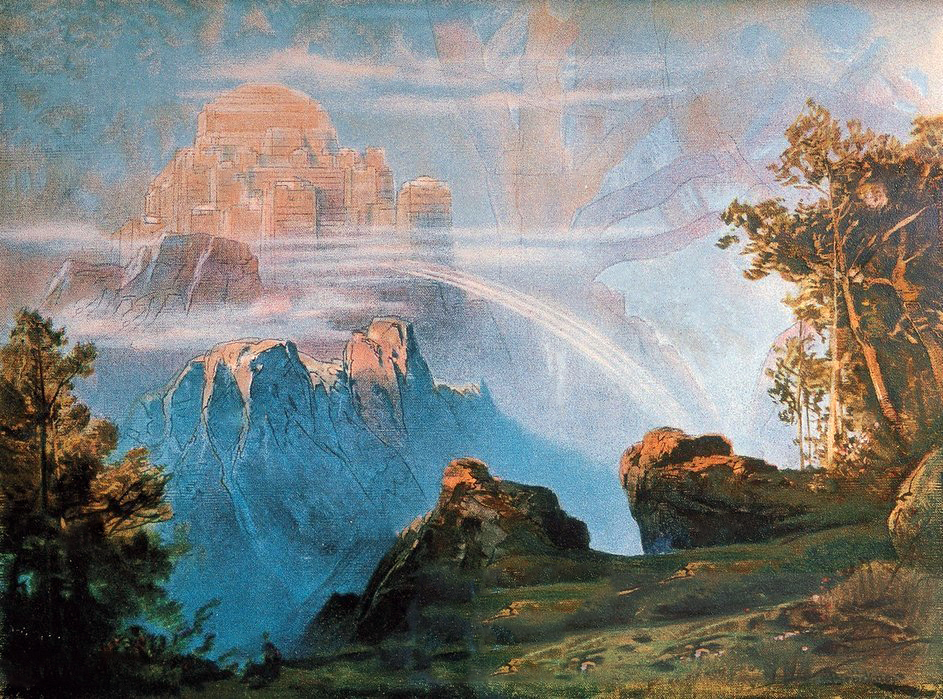
Odin's hall; half of the fallen in battle are borne there by the valkyries.
Valhöll, 'hall of the slain', is Odin's magnificent hall in Ásgarðr. According to Grímnismál it has 540 doors, from each of which 800 einherjar march at Ragnarök. The roof is thatched with golden shields and spears serve as rafters, while the benches are strewn with coats of mail. It is a martial architecture that reflects the hall's function: an eternal and boisterous preparation camp for the final battle.
The daily life of the einherjar in Valhöll is a cycle of combat and feasting. Each morning they ride out onto the plains, fight until they fall, then rise again whole, before riding back to eat and drink with Odin. Their food is the flesh of the boar Sæhrímnir, who is boiled each night and is whole again in the morning; mead flows from the udder of the goat Heiðrún and fills the vat to the brim. The valkyries serve the drink.
Odin himself does not eat at the table; he throws all his food to his wolves Geri and Freki. He drinks wine alone, which is equated with his nature as a god of wisdom and lord of poetry. Valhöll's dual character, as a place of joy and as a war machine, reflects the Old Norse ideal of the warrior's virtue: to die with weapons in hand is the highest privilege.
Sources in the Eddas
- Grímnismál 8-10, 22-25
- Odin describes Valhöll's roof of shields and spears, the boar Sæhrímnir, the goat Heiðrún, and the hall's 540 doors.
- Vafþrúðnismál 41
- The giant Vafþrúðnir confirms that the einherjar gather in Odin's hall and fight every day.
- Völuspá 28
- The völva mentions Valhöll in connection with Odin's preparations for Ragnarök.
- Gylfaginning 38-41
- Snorri provides a coherent description of Valhöll's architecture, the einherjar's daily routine, and the valkyries' role.
Interpretive traditions
A What we know
Valhöll is located in Ásgarðr and belongs to Odin; the souls of warriors slain in battle are brought there by valkyries.
The einherjar prepare daily for Ragnarök through combat and rise unharmed each evening.
The hall is consistently described with shields as roofing and coats of mail on the benches, suggesting a fixed poetic formula.
B What we think we know
Whether all battle-slain went to Valhöll or only a select few is debated; sources suggest Odin chooses the finest warriors.
The number of 540 doors and 800 warriors per door is likely a poetic hyperbole rather than a literal count, but its symbolic meaning is debated.
The relationship between Valhöll and Gimlé as a future gathering place for the righteous after Ragnarök is not fully clarified.
C What we do not know
It is unknown whether Valhöll survives Ragnarök or is destroyed along with the rest of Ásgarðr.
What happens to the einherjar who fall in Ragnarök is not described in the surviving sources.
Valhöll's exact location within Ásgarðr relative to the other gods' halls is not specified.