
About this story
The story of Baldr's dreams, Frigg's oath, Loki's deception, Höðr's shot, the funeral on Hringhorni, Hermóðr's ride to Hel, and Loki's punishment.
A Baldr's Dreams
Baldr, the most radiant of the Aesir, begins to suffer ominous dreams. The nights bring him no peace; the visions are dark and recurring. The gods gather in assembly and deliberate on what the dreams may portend, for all of them understand that the message of dreams must not be dismissed lightly.
Odin resolves to seek knowledge beyond the world of the living. He saddles Sleipnir and rides northward, down the road that leads toward Niflhel. At a burial mound long revered, the last resting place of a völva, he dismounts and begins his sorcery. Through incantations and runes he rouses the dead prophetess from her slumber.
The awakened völva speaks reluctantly. Odin's questions are precise: who will kill Baldr, and who will avenge his death. She answers in the language of prophecy, one answer for each question, until she finally understands who the man before her is. Then she refuses to say more and sinks once again into the silence of death.
Senn váru æsir / allir á þingi,
ok ásynjur / allar á máli;
ok of þat réðu / ríkir tívar,
hví væri Baldri / ballir draumar.
Soon were the gods / all gathered in council,
and the goddesses all / assembled in speech;
and about this deliberated / the mighty powers,
why Baldr was beset / by baleful dreams.
own translation
Upp reis Óðinn, / aldinn gautr,
ok á Sleipni / söðul of lagði;
reið hann niðr / þaðan Niflheljar til,
mœtti hann hvelli / þeim er ór helvegi kom.
Up rose Odin, / the ancient god,
and on Sleipnir / set the saddle;
he rode down / from there toward Niflhel,
he met the hound / that came from the road of Hel.
own translation
A Frigg's Oath
Frigg, alarmed by her son's dreams, takes matters into her own hands. She travels through all the world and extracts an oath never to harm Baldr from everything that exists: fire and water, iron and all metals, stones, soils, trees, diseases, animals, birds, serpents, and poisons. All of these pledge never to become a weapon against Baldr.
One thing is passed over. The mistletoe, small and seemingly insignificant, grows west of Valhöll. Frigg considers it too young and weak to need an oath. This judgment, reasonable at the time, proves to be the gap in Baldr's protection through which fate can enter.
Snorri Sturluson recounts this in Gylfaginning without referring to eddic poems for Frigg's oath itself. The older poetic tradition (Baldrs draumar, Völuspá) presupposes the sequence of events but does not describe the oath in detail. Snorri's prose is the primary source for this episode.
A The Sport of the Gods
With Frigg's oath secured, a new custom arises among the gods: they throw things at Baldr, shoot at him, hack at him with swords, hurl stones. Nothing harms him. It becomes a pastime, a living proof of his invulnerability, and Baldr himself takes laughter and pride in the whole affair.
Loki observes this and it does not sit well with him. He assumes the shape of an old woman and seeks out Frigg in Fensalir. Through skillful questioning he draws from her the information about the oath: that the mistletoe branch had never sworn to spare Baldr, as it had seemed too young.
The Völuspá touches on the scene in concentrated form. The seeress who speaks in that poem foresees Baldr in images of strife and treachery, images that gather around the mistletoe that will fell him. The poetic sources leave much unsaid about exactly how Loki obtained his information; it is Snorri's prose that fills in the picture.
Sá hún Baldri, / blóðgum tívur,
Óðins barni, / ørlög fólgin;
stóð um vaxinn / vestn of velli,
mjór ok mjök fágr / mistilteinn.
She saw for Baldr, / the blood-stained god,
Odin's child, / fate concealed;
stood grown up / west of the plain,
slender and very fair / the mistletoe.
own translation
A Höðr's Shot
Loki takes the mistletoe branch and fashions from it a weapon, an arrow or a javelin. He seeks out Höðr, Baldr's blind brother, who stands apart from the sport and does not participate. Loki offers to guide his hand and help him honor his brother with a throw like the others.
Höðr throws. The mistletoe flies and strikes Baldr. He falls down, dead. It is told that this event was the greatest misfortune to befall gods and men. Among the gods a silence breaks out: no one dares raise a hand against the perpetrator, for the place is a sacred zone of peace.
The Völuspá depicts the death in spare but powerful verse. The sources agree on the basic sequence of events: Loki's cunning, Höðr's blindness, the mistletoe's fateful flight. That Höðr is blind and unknowing of what he does is emphasized in the poetic tradition; he is an instrument, a means through which fate acts rather than a murderer in the full sense of the word.
Varð af þeim / er þótti öllum
Baldrs bróðir / of borinn snemma;
sá nam Óðins sonr / einn döguðu
at vega fyr þat / vígadropa.
There was born / the one who seemed to all
Baldr's brother / early born;
he got Odin's son / alone to fall
to avenge that / with a slaying stroke.
own translation
A The Funeral on Hringhorni
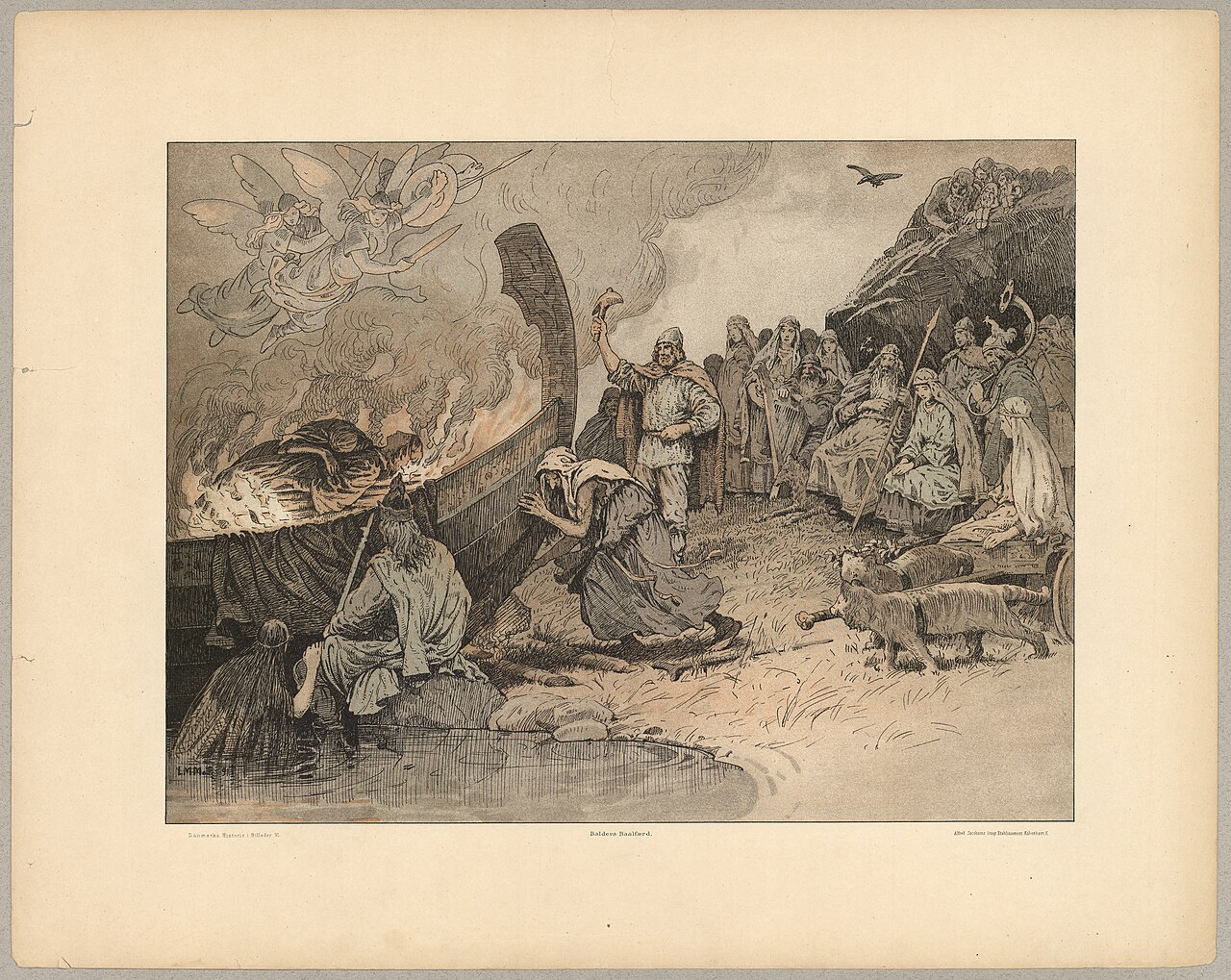
Baldr is to be carried to the sea and cremated aboard his ship Hringhorni, the greatest of all ships. The gods try to launch it but cannot. A messenger is sent to Jotunheimr and brings back the giantess Hyrrokkin. She arrives riding a wolf with a bridle of serpents and sets the ship in motion with a single shove against the prow. Sparks fly and the earth shakes.
Baldr's body is placed on board. His wife Nanna, daughter of Nepr, looks upon the corpse and bursts with grief; her heart breaks and she dies. She is laid beside Baldr on the pyre. Odin places his gold ring Draupnir on the pyre and whispers something into Baldr's ear, a message whose content remains unknown. This suggests that Odin knows something the other gods do not.
Thor hallows the pyre with Mjöllnir, his hammer. In that gesture he accidentally kicks the dwarf Litr, who flies into the flames and burns up. All classes of divine beings are represented at the funeral: Aesir, Vanir, elves, dwarves, and giants. Snorri's account in Gylfaginning makes this a cosmic ceremony of mourning, but the poetic tradition gives us only fragments of the scene.
B Hermóðr's Ride to Hel
The gods mourn and seek counsel. Hermóðr, son of Odin and divine messenger, volunteers to ride to Hel's realm and negotiate for Baldr's return. Odin lends him Sleipnir. Hermóðr rides for nine nights through dark and deep valleys, seeing no light, until he reaches the river Gjöll and passes the guardian of Gjallarbrú, the giantess Móðguðr.
In Hel's hall Hermóðr finds his brother Baldr seated in the place of honor. They speak through the night. The next morning Hermóðr lays his petition before Hel: that Baldr be permitted to return to the living. Hel sets her condition. All things in the world, living and dead alike, must weep for Baldr. If a single creature refuses, Baldr remains with her.
The episode of Hermóðr is related in Gylfaginning as Snorri's prose narrative. Baldrs draumar concerns Odin's ride, and Hermóðr is absent from it. Whether this episode rests on older eddic tradition or is Snorri's own composition from loosely connected motifs remains unresolved in scholarship. Category B is warranted by this source-critical uncertainty.
Hverr er sá drengr / drengja öðrum
þekkr ok þjóðlatr, / þar kominn er?
Hefir þú ok eigi / á ævi þinni
farit at Heljar / hríðarvegi?
Who is this man / among other men
known and of renown / who has come here?
Have you not ever / in your life
traveled toward Hel / along the storm road?
own translation
B Þökk Refuses to Weep
The gods send messengers to every corner of the world with the task of asking all things to weep for Baldr. Everything mourns: people, animals, the earth, stones, and trees, just as these things weep with moisture when they thaw from frost. But on the return journey the messengers encounter a giantess sitting in a cave. She calls herself Þökk.
The messengers ask Þökk to weep for Baldr. She refuses flatly. In the strophes preserved by Snorri she answers that Baldr never did her any good, that she mourns him neither living nor dead, and that Hel may keep what she has. With that, Baldr's fate is sealed.
The tradition is nearly unanimous that Þökk is Loki in disguise, but this is not stated explicitly in the poetic fragments. It is a plausible and well-founded conclusion to the narrative: Loki, whose cunning killed Baldr, also prevents his return. Historiographically this episode depends largely on Gylfaginning as its sole coherent source.
Þökk mun gráta / þurrum tárum
Baldrs bálfarar;
kyks né dauðs / nautk-a ek Karls sonar;
haldi Hel þvat hefir.
Þökk will weep / with dry tears
at Baldr's pyre;
neither living nor dead / did I gain from Karl's son;
let Hel keep what she has.
own translation
A Loki's Punishment
The gods realize that Þökk was Loki and that he thus bears responsibility for Baldr's continued stay in Hel. They seize him. Loki tries to flee and hides in a waterfall in the shape of a salmon, but the Aesir catch him with a net. He is taken to a cave beneath the earth and bound with the entrails of his son Narfi, whom his other son Váli had torn apart in wolf-shape.
Skaði, the giantess, hangs a serpent above Loki so that venom drips into his face. His wife Sigyn sits beside him and holds a bowl beneath the serpent to catch the poison. But when the bowl is full she must empty it, and in that moment the drops strike Loki. He writhes in agony, and from that the whole earth shakes. This is what we call an earthquake.
The binding of Loki corresponds to a well-known mythic pattern of the temporary internment of the chaotic principle. The Völuspá touches on the episode briefly but firmly. The prose epilogue of Lokasenna gives a more detailed account. Loki is to lie bound until Ragnarök, when the bonds will break and he will sail to sea on his ship Naglfar.
Sá hún liggja / und Hveralundi
lægjarns líki / Loka ætlíkan;
þar sitr Sigyn / þeygi um sínum
ver velglýjuð. / Vituð ér enn, eða hvat?
She saw lying / under Hveralundr
in fetters' form / in likeness of Loki;
there sits Sigyn / by no means glad
over her husband. / Do you know yet, or what?
own translation
Þá var Loki tekinn griðalauss ok farit með hann í helli nökkurn.
Þá tóku þeir Narfa, son Loka; en Váli, sonr hans, varð at úlfi
ok reif Narfa í sundr.
Þá tóku æsir þarma hans ok bundu Loka.
Then Loki was taken without mercy and brought to a certain cave.
Then they took Narfi, Loki's son; but his son Váli became a wolf
and tore Narfi apart.
Then the Aesir took his entrails and bound Loki.
own translation
Interpretive traditions
A What we know
Those core episodes attested in at least two independent sources, eddic poetry and/or Gylfaginning, are treated as historically reliable in the sense that they were part of the Old Norse mythological tradition as Snorri knew it around 1220 CE.
Baldr's death, his funeral on Hringhorni, and Loki's final capture all belong to category A: they are depicted consistently in sources not dependent on each other and appear to have belonged to a stable mythological core.
The Völuspá (strophes 31-35) and Gylfaginning constitute the most important primary sources. Baldrs draumar gives Odin's ride an independent poetic form and is probably older than Snorri's summary.
B What we think we know
Hermóðr's ride to Hel and Þökk's refusal to weep are categorized as B because they appear in coherent form only or primarily in Gylfaginning. Snorri's source references are absent for these passages.
The identification of Þökk with Loki is an inference that the preserved texts support but do not state explicitly. It is a reconstruction of high probability, but a reconstruction nonetheless.
The question of whether Baldr's myth has Christian parallels (the innocent god who dies and returns) is an old debate in scholarship. Research from Axel Olrik to Margaret Clunies Ross suggests that the similarities are likely superficial and that the motif of Baldr's death is primarily mythological rather than theologically borrowed.
C What we do not know
The message Odin whispered into Baldr's ear at the pyre remains unknown. Snorri mentions it but provides no answer. Plausible interpretations include: a promise of Baldr's return after Ragnarök, a word of sorcery, or a word concerning Odin's own fate.
Baldr's mythic prehistory and his precise role in pre-Christian cult is unattested. The theory of a Baldr-cult with Scandinavian place-name traces is debated and lacks direct archaeological evidence.
What Hel actually said to Baldr during Hermóðr's visit, if they spoke of anything beyond what is recounted, is entirely unknown. Snorri implies that Baldr occupied a position of honor with Hel, but nothing more can be read from the text.