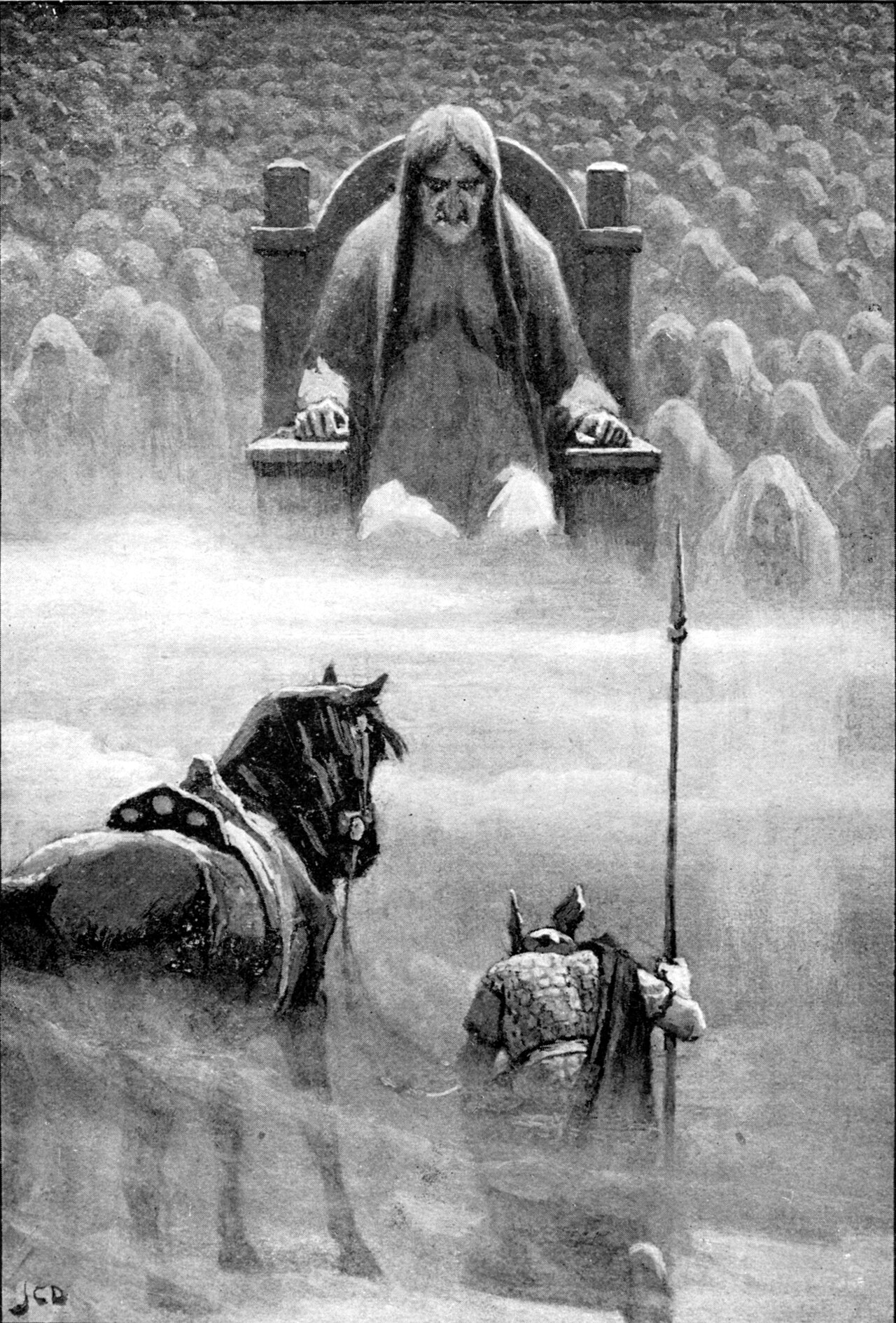
Daughter of Loki and Angrboða; ruler of the realm of Hel beneath one of Yggdrasil's roots.
Hel is the daughter of Loki and the giantess Angrboða, sister to Fenrir and Jörmungandr. Odin cast her down into Niflheimr and gave her dominion over the dead who do not fall in battle, those who die of illness, old age, and accident. Her realm, also called Hel, lies deep beneath the roots of the earth and is reached by the road downward and northward.
Hel's physical appearance is one of the most striking features of Old Norse myth. Gylfaginning describes how half her body is living and normal in complexion, while the other half is blue-black and corpse-like. This outward bisection mirrors her role as a boundary-figure between life and death. Her hall Eljudnir (wind-beaten by storms) contains the furnishing Hungr (hunger) as her table and Sultr (drought) as her knife, and her servants bear names suggesting bleak desolation.
The most dramatic episode involving Hel is the aftermath of the Baldr myth in Baldrs draumar and Gylfaginning. After Baldr is slain by the mistletoe and travels to Hel's realm, the Aesir send Hermodr on his nine-day ride through dark valleys to implore Hel for Baldr's release. Hel sets the condition that everything in the world, living and dead, must weep for Baldr. Everything weeps except Þökk, the giantess who is presumably Loki in disguise, and Baldr remains in Hel until after Ragnarok.
Hel's boundary-crossing character makes her a key figure for understanding the Old Norse conception of death. Unlike Valhöll's battle-heroes, most mortals have no glorified afterlife in her realm. Hel's neutral-bleak sphere represents a different aspect of eschatology, namely the path of ordinary dying, in contrast to Odin's chosen champions.
Sources in the Eddas
- Baldrs draumar
- Depicts Odin's ride to Hel's gate and the raising of a völva who reveals Baldr's fate in the underworld.
- Völuspá 43-46
- Describes Baldr's death and the grief of the Aesir, with Hel's realm as the destination.
- Lokasenna 23
- Loki mentions his children including Hel in the enumeration of his offspring.
- Gylfaginning 34, 49
- Snorri's full description of Hel's half-dead appearance, her hall Eljudnir, and her condition for Baldr's release.
- Vafþrúðnismál 43
- Confirms that Hel's realm is the destination for those who die of illness and old age, as distinct from Valhöll.
Interpretive traditions
A What we know
Hel is the daughter of Loki and Angrboða, cast into Niflheimr by Odin, attested in Gylfaginning and Lokasenna.
Her hall Eljudnir and the furnishings Hungr and Sultr are consistently attested in Snorri.
She sets the condition of universal weeping for Baldr's release, one of the best-attested episodes in the mythology.
B What we think we know
It is debated whether 'Hel' as a realm and 'Hel' as a person were originally distinct concepts that were merged.
Hel's relationship to Niflheimr and Náströnd at Ragnarok is terminologically unclear in the sources.
C What we do not know
It is unknown whether Hel received cultic veneration in pre-Christian Nordic religion or was solely a mythological personification.
Hel's exact cosmological position relative to other subterranean spaces such as Náströnd and Niðafjöll has not been established.